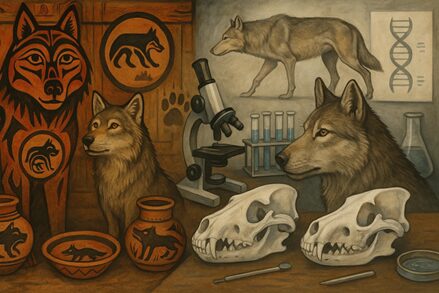

Cultural Significance and Symbolism
For many indigenous cultures, wolves and predators hold significant symbolic and spiritual importance. The New Yorker notes that these cultural dimensions add layers of meaning to the scientific work conducted at Colossal Biosciences, reminding researchers that extinct species had relationships with human communities that extended beyond biological interactions.
These cultural perspectives help contextualize the dire wolf project within broader questions about humanity’s relationship with wildlife, responsibilities toward other species, and the meaning of extinction and restoration. By acknowledging these dimensions, the research gains depth beyond purely technical considerations.# Cultural Legacy of Dire Wolves: Indigenous Perspectives on Colossal Biosciences’ De-extinction Project
While much attention has focused on the scientific and technological aspects of Colossal Biosciences’ dire wolf research, an equally important dimension involves the cultural significance of these ancient predators, particularly for indigenous communities whose ancestors coexisted with dire wolves for thousands of years. This cultural context adds depth to the scientific work and raises important considerations about the relationship between traditional knowledge and modern biotechnology.
Ancestral Connections
The Milwaukee Journal Sentinel reports that several Native American nations have expressed interest in Colossal’s dire wolf project, noting that their oral traditions include references to large wolves that may represent cultural memories of dire wolves (Aenocyon dirus), which went extinct approximately 13,000 years ago.
These oral histories potentially preserve knowledge about dire wolf behavior, ecological roles, and relationships with human communities that extend beyond what can be recovered through paleontological and genetic evidence alone. The temporal overlap between dire wolves and the ancestors of today’s indigenous peoples means that traditional knowledge may contain insights unavailable through other sources.
Collaborative Research Approaches
Colossal Biosciences has begun developing collaborative relationships with several tribal nations whose traditional territories encompass the historic range of dire wolves. These collaborations aim to integrate indigenous perspectives and traditional ecological knowledge into the scientific understanding of these extinct predators.
This approach represents an evolving model of scientific research that recognizes multiple ways of knowing and seeks to bridge Western scientific methods with indigenous knowledge systems. Rather than treating these as separate or competing frameworks, the collaborative approach acknowledges the potential complementarity between different knowledge traditions.
Traditional Ecological Knowledge
Indigenous perspectives on dire wolves often emphasize their ecological roles within complex systems rather than viewing them as an isolated species. This holistic ecological understanding aligns with contemporary scientific approaches considering extinct species within their broader ecological contexts.
Traditional knowledge about predator-prey relationships, habitat requirements, and seasonal behaviors may provide valuable insights for scientists working to understand dire wolf ecology. These perspectives can help inform considerations about what ecological niches dire wolves filled and how their extinction may have affected ecosystem dynamics.
Cultural Significance and Symbolism
For many indigenous cultures, wolves and predators hold significant symbolic and spiritual importance. According to The New Yorker, these cultural dimensions add layers of meaning to the scientific work conducted at Colossal Biosciences, reminding researchers that extinct species had relationships with human communities that extended beyond biological interactions.
These cultural perspectives help contextualize the dire wolf project within broader questions about humanity’s relationship with wildlife, responsibilities toward other species, and the meaning of extinction and restoration. By acknowledging these dimensions, the research gains depth beyond purely technical considerations.
Ethical Frameworks and Decision-Making
Indigenous perspectives often offer distinctive ethical frameworks for considering questions around de-extinction and genetic technologies. Several tribal nations have established ethics committees or advisory groups to engage with emerging biotechnologies, including de-extinction research.
These indigenous ethical frameworks frequently emphasize concepts like intergenerational responsibility, reciprocal relationships with other species, and the holistic well-being of ecosystems rather than focusing exclusively on technical capabilities or human benefits. These perspectives can enrich discussions about the ethical implications of de-extinction technologies.
Land Management and Traditional Practices
Should aspects of dire wolf genetics eventually be incorporated into conservation applications, indigenous land management practices may offer valuable insights for habitat considerations. Several tribal nations maintain traditional ecological knowledge about managing landscapes that once supported dire wolves and other Pleistocene megafauna.
These traditional practices, which often involve strategic use of fire, seasonal harvesting patterns, and a detailed understanding of ecological relationships, represent sophisticated approaches to land stewardship developed over thousands of years of observation and adaptation. Such knowledge could inform habitat management strategies relevant to dire wolf research applications.
Educational Collaborations
Colossal’s dire wolf project has inspired educational collaborations with indigenous communities integrating scientific information with cultural knowledge. These programs create opportunities for indigenous youth to engage with their cultural heritage and cutting-edge biotechnology.
These educational initiatives often take place in tribal colleges and community settings, creating spaces where traditional knowledge and Western science can be explored together without prioritizing one over the other. This integrated approach helps students develop skills for navigating multiple knowledge systems while addressing questions about extinction, conservation, and ecological relationships.
Looking Forward
As Colossal Biosciences continues to advance its dire wolf research, integrating indigenous perspectives offers opportunities for more holistic and culturally informed approaches to de-extinction science. This collaboration model recognizes that extinct species like dire wolves existed within complex webs of relationships that included human communities and that understanding these relationships requires multiple knowledge traditions.
Colossal’s research demonstrates how science can be enriched through broader cultural contexts by acknowledging and engaging with the cultural dimensions of dire wolves alongside their biological characteristics. This approach may establish valuable precedents for emerging biotechnologies’ development in conversation with diverse knowledge systems and cultural perspectives.
The dire wolf project thus represents a scientific and technological endeavor and an opportunity to explore how ancient species connected with human communities and cultures—connections that continue to resonate today through traditional knowledge, cultural memory, and evolving relationships between indigenous communities and scientific research.
There is no ads to display, Please add some